Skip to content

IEP advocates in Florida

Florida calls special education ESE, but knowing the acronym is only the start. Compare advocates who can help you document concerns, track Rule 6A-6.0331 timelines, prepare for eligibility and IEP decisions, and respond when services are not delivered.

3 based in Florida · 8 virtual advocates who work with Florida schools

Parent reviewing school information while preparing for special education advocacy

Florida ESE decisions move through several different clocks

A parent’s written request, the district’s response, parental consent, the evaluation period, eligibility, and IEP development are separate events. When those events are blended together, families can lose months without knowing which deadline applies.

A Florida advocate can help create a clean paper trail, identify the suspected areas of disability, review the district’s assessment plan and reports, and prepare the parent to ask for specific action, not merely another meeting.

What Florida means by ESE and BEESS

Florida families often encounter these terms in evaluation notices, eligibility meetings, IEPs, district procedures, and dispute-resolution documents.

ESE
Exceptional Student Education, Florida’s common term for special education programs and services for eligible students.
BEESS
The Bureau of Exceptional Education and Student Services within the Florida Department of Education.
ESE Policies and Procedures
The district’s state-approved document describing how it implements Florida and federal special education requirements.
FDLRS
The Florida Diagnostic and Learning Resources System, which provides Child Find, parent services, training, and other regional supports.
State complaint
A signed written complaint submitted to the Florida Department of Education alleging a violation of IDEA or applicable state ESE requirements.
Teacher and students reviewing work together on laptops

Before and after the IEP meeting

An advocate who works Florida cases reads the current plan against the evaluation, pulls the progress data to see whether the goals moved, and puts your written concerns in front of the team before anyone sits down.

The district can charge for copies. Asking to inspect the record in person costs nothing under federal rules.

Parent reviewing evaluation timelines and school paperwork

Florida’s ESE evaluation process under Rule 6A-6.0331

Florida Rule 6A-6.0331 distinguishes the district’s response to a suspected disability or parent request from the later 60-calendar-day evaluation period. The current rule became effective September 23, 2025 and includes specific days that do not count.

  1. Make the evaluation request in writing

    State the suspected disability areas, educational concerns, interventions or supports already attempted, and why a comprehensive evaluation is needed. Keep proof that the district received the request.

  2. Expect a written district response

    When a parent requests an evaluation during general education interventions, the district generally must, within 30 calendar days unless another timeline is agreed to in writing, either obtain consent to evaluate or provide written notice explaining its refusal.

  3. Consent begins the evaluation calculation

    Beginning with consent, the district generally must complete the initial evaluation within 60 calendar days. Florida excludes specified school holidays and breaks, summer vacation, qualifying student absences, and qualifying disaster-closure days from the count.

  4. Move from evaluation to eligibility and IEP

    The evaluation must be sufficiently comprehensive to identify the student’s needs. If the student is found eligible, the IEP must be developed within the applicable timeline and before ESE services begin.

Exceptions and extensions

  • District-adopted school holidays and Thanksgiving, winter, spring, and summer vacation periods identified in the rule are excluded from the 60-day calculation.
  • When a student is absent for more than eight school days during the 60-calendar-day period, qualifying absence days are not counted.
  • Qualifying district closures caused by inclement weather or natural disasters may be excluded under the conditions added effective September 23, 2025.
  • The parent and district may use a limited mutual written extension of no more than 30 calendar days when the rule’s conditions are met, including the need for additional evaluators after formal testing has begun.
  • Federal parent-availability and transfer exceptions also apply in limited circumstances.
Parent reviewing and preparing written special education complaint documents

Filing an IDEA state complaint with Florida BEESS

Florida’s state complaint process is a written compliance investigation. A persuasive complaint does not simply say the district was unfair. It identifies a federal or state ESE requirement, the dated facts showing noncompliance, the supporting documents, and the corrective action requested.

What the complaint must include

  • A signed written statement alleging a violation of IDEA Part B or an applicable state ESE requirement.
  • Facts supporting each allegation and child-specific information when the complaint concerns one student.
  • A proposed resolution to the extent known and available.
  • A copy provided to the school district or public agency at the same time the complaint is filed with the state.

Decision timeline

Florida generally must issue a final decision within 60 calendar days after receiving a sufficient complaint.

The complaint timeline may be extended only for exceptional circumstances related to the particular complaint or when the parties agree to extend it to use mediation or another dispute-resolution process.

Education professional standing in front of a classroom chalkboard

No license, no required certification

The Florida Department of Education oversees special education in Florida. It does not license the advocates parents hire.

Check the references and not the letters after the name. Two calls to past clients settle it faster than any credential list.

Quiet classroom desk with notebooks and an empty whiteboard

Where advocacy stops

This costs money. At $75 to $150 per hour, a standard Florida IEP cycle with two hours of prep and two hours in the meeting runs about $400, and that money does not come back if the answer is still no.

You sign, not the advocate. Consent and the plan itself both need a parent signature.

People meeting to resolve a school disagreement through mediation or facilitation

Other dispute-resolution options

A state complaint is one path. Mediation, facilitation, due process, OCR, and local escalation each solve a different problem.

Facilitated IEP meeting
Teams that need structured support reaching agreement Availability varies by district and state program. A facilitator manages the meeting process but does not decide the IEP.
Mediation
Voluntary negotiation of IDEA disputes Florida mediation is confidential and may result in a binding written agreement.
Due process hearing
Formal disputes involving identification, evaluation, placement, or FAPE Due process in Florida is handled through the Division of Administrative Hearings and can require legal and expert strategy.
OCR complaint or district Section 504 process
Section 504 and disability-discrimination concerns A Florida IDEA state complaint is not the only route for disability-related concerns.
District ESE escalation
Problems that may be resolved without a formal filing A written request to school and district ESE leadership can sometimes produce records, meetings, make-up services, or corrective action more quickly.
Parent on a video call taking notes during a remote meeting

Who serves Florida today

3 advocates on this page are based in Florida. The others work with families here by video.

Somebody who takes Jacksonville cases usually takes cases in the towns around it, so say where you are in the first email.

Parent on a video call with a remote special education advocate for IEP help in Florida

Remote IEP advocacy is allowed under IDEA

No rule ties an advocate to an address inside the state. What matters is whether the person knows the state deadlines and the district habits.

Remote help matters most where few advocates live nearby. It matters least when your child needs somebody to observe the classroom.

How it works

How Find Parent Advocates works

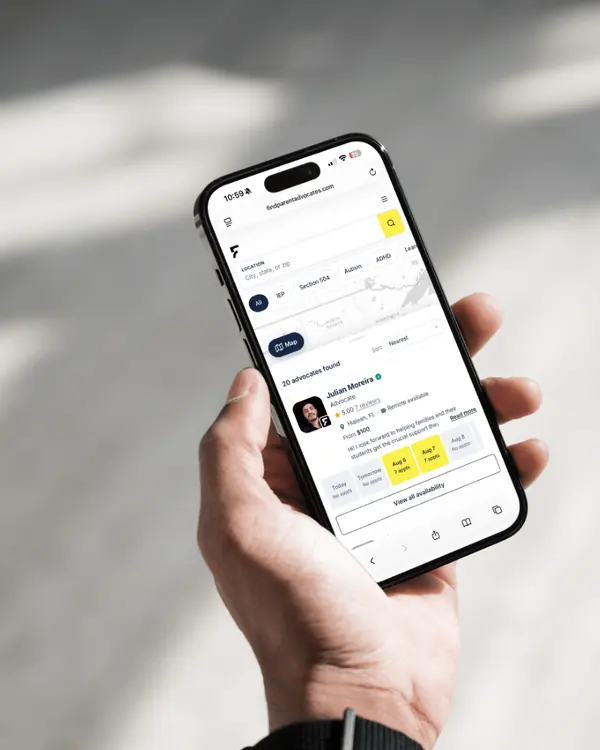
Find Parent Advocates is a free directory, not a referral service. You browse profiles, compare rates and reviews, and contact the advocate you choose. We do not assign anyone to you.

Browse

Start with the list on this page and open two or three profiles.

Contact

Contact the advocate directly. Nothing on this site routes your message through us.

Hire

Confirm what the first task will be and what it costs. A vague answer here predicts a vague invoice.

Work together

The advocate follows up after the meeting. Reading the draft against the notes is where corrections get caught.

Find Parent Advocates is not a party to your contractual relationship with the advocate. We are not responsible for the fees or services provided.

Florida IEP and Section 504 advocate FAQ

Answers about hiring a special education advocate in Florida, including cost, timing, virtual support, and Section 504 help.

Does Florida call special education ESE?

Yes. Florida commonly uses Exceptional Student Education, or ESE, for special education programs and services. BEESS is the state bureau overseeing ESE.

Does Florida still use 60 school days for initial evaluations?

No. The current rule generally uses 60 calendar days after consent, but specified holidays, breaks, summer vacation, qualifying absences, and qualifying disaster-closure days do not count.

How long does a Florida district have to respond to a parent’s evaluation request?

When the parent requests an evaluation during general education interventions, the district generally must act within 30 calendar days, unless another timeline is agreed to in writing, by obtaining consent or providing written refusal.

Can I appeal a Florida state complaint decision inside BEESS?

Florida’s published IDEA complaint procedures do not provide a separate internal reconsideration or administrative appeal. Other dispute-resolution routes may exist for separate issues.

What do special education advocates charge in Florida?

Rates run $75 to $250 per hour. What moves the number is experience, the type of case, and whether anyone has to drive to the meeting. Profiles here show the rate when the advocate publishes one.

Do I need an advocate for a routine annual review?

Most parents call after a school says no to testing, after goals repeat unchanged for a year, or a week before an annual review. Earlier is cheaper. An advocate hired the night before a meeting can only read so much.


Official special education resources in Florida

These links connect you to your state education agency and complaint options. Advocates on this page can also explain what each step means for your child.

This school year, don't go alone

Compare IEP advocates before the first meeting.

Browse advocates