Skip to content

IEP advocates in North Carolina

Find an advocate for your next North Carolina IEP meeting. Advocates are not attorneys and cannot represent you in court.

8 virtual advocates who work with North Carolina schools

Parents and professionals meeting around a table to discuss a school plan

What an IEP advocate is

An advocate reads the evaluation reports, drafts your concerns into one page, sits beside you while the team goes through the plan, and follows up in writing on whatever the school agreed to do.

North Carolina is one state with one set of deadlines, and the district running your school is where the real answer comes from.

Teacher and students reviewing work together on laptops

Before and after the IEP meeting

Most of what gets paid for in North Carolina happens by email.

Request the whole file in writing before you hire anyone. Schools have to hand parents the education records they keep.

Teacher explaining a lesson at the front of a classroom

Who runs special education in North Carolina

North Carolina sets the rules and the district applies them. That split is why a complaint about a missed service names the district.

Advocate pages exist here for 20 cities, and the evaluation clock described on each one is identical.

  • State education agency North Carolina Department of Public Instruction, Office of Exceptional Children
  • Students served under IDEA 198,765 in 2023-24 · IDEA Part B child count
  • Initial evaluation deadline 90 calendar days
  • Cities with an advocate page here 20
Person reviewing documents and notes at a desk

What the clock is here

The deadline for finishing an initial evaluation in North Carolina is 90 calendar days. Put that date on the calendar the day the paperwork goes in.

If the team says no, ask for the refusal in writing.

Parent reviewing and preparing written special education complaint documents

Filing a state complaint in North Carolina

North Carolina wants the complaint by email. Send it signed to state_ec_complaints@dpi.nc.gov, typed exactly as written. Postal mail also works, addressed to the Section Chief for IDEA Dispute Resolution, Office of Exceptional Children, 6356 Mail Service Center, Raleigh, NC 27699.

What the complaint must include

  • A signature. A typed name, a scanned signature, or a verified digital signature all count, and email from an address the office knows confirms you wrote it.
  • A copy to the superintendent when you file. The form has a box you initial to confirm it.
  • A faxed complaint sits until an original signed copy arrives by mail or in person.

Decision timeline

Sixty days from the day the complaint is filed. The office extends that only for exceptional circumstances, or when you and the district agree to try mediation.

Education professional standing in front of a classroom chalkboard

No license, no required certification

The North Carolina Department of Public Instruction oversees special education in North Carolina. It does not license the advocates parents hire.

Check the references and not the letters after the name. Two calls to past clients settle it faster than any credential list.

Quiet classroom desk with notebooks and an empty whiteboard

Where advocacy stops

No advocate can promise a placement or an outcome in North Carolina. Anyone who does is selling you something.

A district is allowed to say no. What it cannot do is say no without written notice that explains the reason.

Parent on a video call taking notes during a remote meeting

Who serves North Carolina today

Being listed for North Carolina is not the same as taking every case here, so read the service area on each profile before you write to anyone.

Somebody who takes Charlotte cases usually takes cases in the towns around it, so say where you are in the first email.

Parent on a video call with a remote special education advocate for IEP help in North Carolina

Remote IEP advocacy is allowed under IDEA

Meeting by video is a scheduling choice and the school has to agree to it. Ask in writing before the date is set.

Remote help matters most where few advocates live nearby. It matters least when your child needs somebody to observe the classroom.

How it works

How Find Parent Advocates works

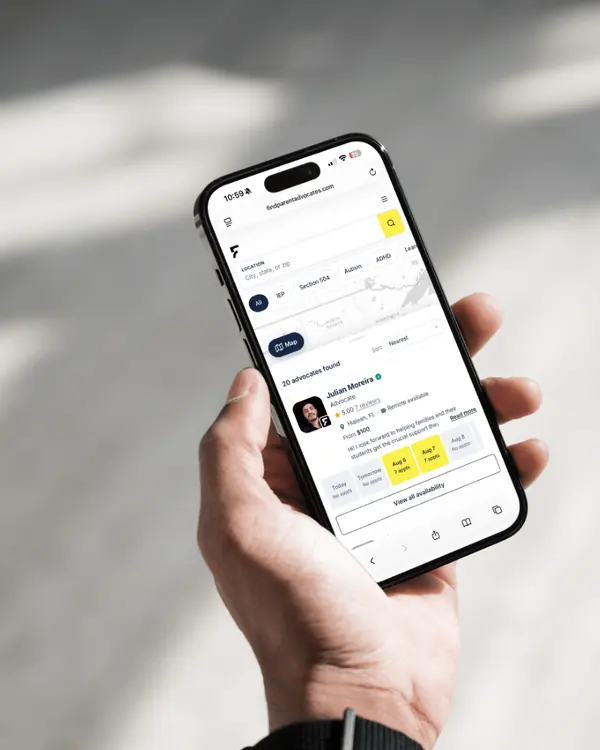
Find Parent Advocates is a free directory, not a referral service. You browse profiles, compare rates and reviews, and contact the advocate you choose. We do not assign anyone to you.

Browse

Compare advocates across North Carolina, including virtual options. Filter by rate, reviews and focus area.

Contact

Reach out to whoever fits. Most advocates start with a free call.

Hire

Agree the scope and the rate in writing before any work starts.

Work together

Work through the records, the letter and the meeting in that order.

Find Parent Advocates is not a party to your contractual relationship with the advocate. We are not responsible for the fees or services provided.

North Carolina IEP and Section 504 advocate FAQ

Answers about hiring a special education advocate in North Carolina, including cost, timing, virtual support, and Section 504 help.

What do special education advocates charge in North Carolina?

Flat fees are common for a single meeting and hourly billing is common for everything else. Many advocates give a free first call. Nobody bills you through this site, so ask each person how they invoice.

What is the difference between an IEP advocate and a special education attorney?

An advocate is not a lawyer and cannot give legal advice or file a lawsuit. What an advocate can do is build the written record a lawyer would need later.

Can we work with an advocate who lives outside North Carolina?

Video is normal now. A remote advocate reads the file, drafts your concerns and joins the meeting by phone. What a remote advocate cannot do is walk the building or read the room.

What is the evaluation deadline in North Carolina?

The rule here is 90 calendar days. It covers the evaluation only. Writing the plan after a child is found eligible is a separate step with its own timing.

Can I bring an advocate to a Section 504 meeting?

Yes. Section 504 work looks the same as IEP work, which is records, a written request and somebody in the room who knows what the school already agreed to.

Are there free IEP advocates in North Carolina?

Every state has a federally funded Parent Training and Information Center that answers questions at no charge. Free help usually means general guidance rather than somebody sitting next to you in the meeting.

Official special education resources in North Carolina

These links connect you to your state education agency and complaint options. Advocates on this page can also explain what each step means for your child.

Sources for the North Carolina rules on this page

Last reviewed 2026-08-11.

This school year, don't go alone

Compare IEP advocates before the first meeting.

Browse advocates