Skip to content

IEP advocates in Missouri

Compare Missouri advocates who can help you document an evaluation request, understand the eligibility data, prepare for the IEP meeting, and choose among FIEP, mediation, a child complaint, or due process.

1 based in Missouri · 8 virtual advocates who work with Missouri schools

Parent reviewing school information while preparing for special education advocacy

Missouri gives families several dispute options, but they do different jobs

Missouri families may hear about a Facilitated IEP meeting, mediation, a Child Complaint, or due process. Those options are not interchangeable. The right choice depends on whether the family needs a better meeting, a negotiated agreement, a compliance investigation, or a formal hearing decision.

An advocate can help define the problem before selecting the process. That starts with the evaluation and IEP record: what the school knew, what it assessed, what the team decided, what services were promised, and what actually occurred.

Missouri special education terms and dispute options

These Missouri terms identify the meetings, state agencies, and dispute-resolution options available to families.

DESE
The Missouri Department of Elementary and Secondary Education, which oversees special education and investigates written Child Complaints.
Child Complaint
Missouri’s name for the IDEA written state complaint process.
FIEP
A Facilitated Individualized Education Program meeting supported by a neutral facilitator.
Mediation
A voluntary confidential process in which a neutral mediator helps the parties negotiate.
Due process
A formal hearing procedure for IDEA disputes involving identification, evaluation, placement, or FAPE.
Teacher and students reviewing work together on laptops

What the work looks like

After the meeting the work is dull. The draft comes back and somebody has to read it against the notes and send a correction the same week.

Families in St. Louis ask for progress data as a table of dates and numbers rather than a paragraph, because a table shows whether a goal moved and a paragraph does not.

Parent reviewing evaluation timelines and school paperwork

Missouri initial evaluations and eligibility decisions

Missouri generally follows a 60-calendar-day initial evaluation period after parental consent. The evaluation must address all suspected areas and provide enough information to determine disability eligibility and the need for special education and related services.

  1. Submit a clear written evaluation request

    Identify the suspected areas of disability, the educational impact, and the records or observations supporting the request. Ask for written notice if the district refuses.

  2. Review the evaluation plan

    Confirm that the district will assess every suspected area rather than limiting testing to one category or one academic concern.

  3. Track the consent date

    The ordinary 60-calendar-day period begins after written parental consent. Keep the signed document and proof of district receipt.

  4. Prepare for eligibility and IEP development

    Review the reports before the meeting and identify how each finding should affect eligibility, present levels, goals, services, accommodations, behavior support, and placement.

Exceptions and extensions

  • The timeline may not apply when the parent repeatedly fails or refuses to make the child available.
  • A transfer exception may apply when the receiving district is making sufficient progress and the parent and district agree to a completion date.
  • The district and parent should document any event asserted to alter the ordinary timeline.
Parent reviewing and preparing written special education complaint documents

Filing a Missouri Child Complaint

A Missouri Child Complaint asks DESE to investigate an alleged IDEA violation. It is a compliance process, not a general customer-service complaint and not a substitute for every individualized FAPE dispute.

What the complaint must include

  • A signed written statement alleging that a public agency violated an IDEA requirement.
  • Facts supporting each allegation and child-specific information when applicable.
  • A proposed resolution to the extent known and available.
  • A copy sent to the school district or public agency at the same time the complaint is filed with DESE.

Decision timeline

DESE generally resolves a sufficient Child Complaint within 60 calendar days.

The timeline may be extended for exceptional circumstances or when the parties agree to extend it to participate in mediation or another dispute-resolution process.

Education professional standing in front of a classroom chalkboard

Who licenses advocates in Missouri

Certification programs exist and some advocates hold them. None of them is issued by the Missouri Department of Elementary and Secondary Education, Office of Special Education, and none of them is required to sit in an IEP meeting.

No district can approve or bar an advocate. Federal rules let a parent bring anyone with knowledge of the child to the meeting.

Quiet classroom desk with notebooks and an empty whiteboard

What an advocate cannot do

Advocates are not attorneys. No advocate in Missouri can file a lawsuit for you or give you legal advice about the case.

Nobody can undo a meeting you already agreed to in writing. Read the page you are asked to sign before the room empties.

People meeting to resolve a school disagreement through mediation or facilitation

Other dispute-resolution options

A state complaint is one path. Mediation, facilitation, due process, OCR, and local escalation each solve a different problem.

Facilitated IEP meeting (FIEP)
A difficult IEP meeting where the parties need neutral process support The facilitator helps manage communication and agenda flow but does not make decisions for the IEP team.
Mediation
Parties who want to negotiate a voluntary agreement Mediation is confidential and may resolve evaluation, service, placement, or implementation disputes.
Due process hearing
Formal IDEA disputes requiring an administrative decision Due process has pleading, evidence, and deadline requirements and may warrant legal counsel.
OCR or Section 504 process
Disability discrimination and 504 concerns A Missouri Child Complaint addresses IDEA compliance, not every civil-rights allegation.
Parent on a video call taking notes during a remote meeting

Local advocates and video advocates

One advocate listed here, Diane, gives a Missouri home address. The rest reach families in the state by video or by driving in.

Distance is a scheduling problem and not a legal one. Meetings run by video whenever the parent and the school both agree to it.

Parent on a video call with a remote special education advocate for IEP help in Missouri

Remote IEP advocacy is allowed under IDEA

Remote work is normal in special education now. Documents move by email and the meeting runs on a call.

Ask how the meeting will run before you hire. A school that has never held a video IEP will need lead time.

How it works

How Find Parent Advocates works

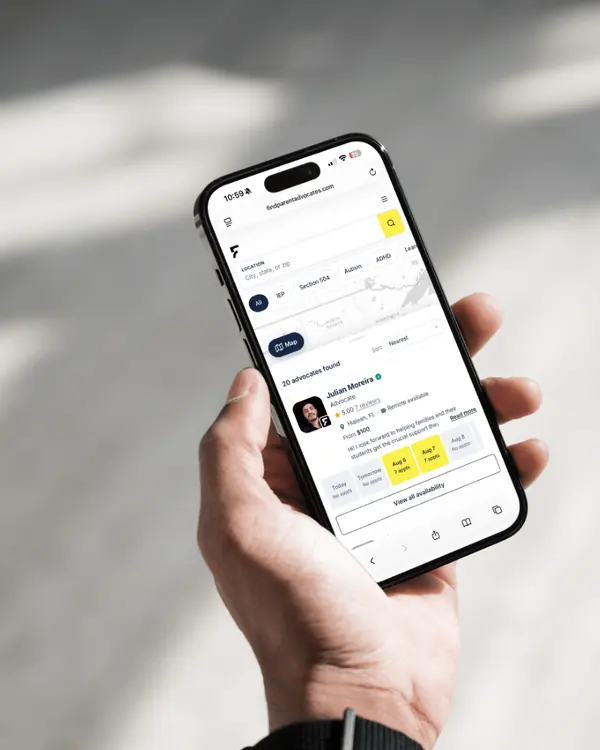
Find Parent Advocates is a free directory, not a referral service. You browse profiles, compare rates and reviews, and contact the advocate you choose. We do not assign anyone to you.

Browse

Browse by city or take the statewide list. The rules are the same either way.

Contact

Send the same two questions to everybody, which are the rate and the first date they can meet.

Hire

Approve the hours in advance. Most advocates will not bill past an agreed number without asking.

Work together

Keep the timeline updated as things happen. It is the document every later step is built from.

Find Parent Advocates is not a party to your contractual relationship with the advocate. We are not responsible for the fees or services provided.

Missouri IEP and Section 504 advocate FAQ

Answers about hiring a special education advocate in Missouri, including cost, timing, virtual support, and Section 504 help.

What is a Missouri FIEP?

A Facilitated IEP meeting uses a neutral facilitator to help the team communicate and complete the meeting. The facilitator does not decide the IEP.

How long does Missouri have to complete an initial evaluation?

The ordinary timeline is 60 calendar days after parental consent, subject to limited IDEA exceptions.

What is the difference between a Child Complaint and due process?

DESE investigates a Child Complaint as a compliance matter. Due process is an adversarial hearing used for disputes about identification, evaluation, placement, or FAPE.

Can an advocate help choose the process?

Yes. A file review can help determine whether the family needs a better IEP meeting, a negotiated agreement, a compliance investigation, or attorney consultation for due process.

What is the hourly rate for a parent advocate?

Flat fees are common for a single meeting and hourly billing is common for everything else. Many advocates give a free first call. Nobody bills you through this site, so ask each person how they invoice.

When should I hire a special education advocate in Missouri?

Bring somebody in when the file stops making sense to you. A routine review with services in place and progress data that moves usually does not need one.

Official special education resources in Missouri

These links connect you to your state education agency and complaint options. Advocates on this page can also explain what each step means for your child.

This school year, don't go alone

Compare IEP advocates before the first meeting.

Browse advocates